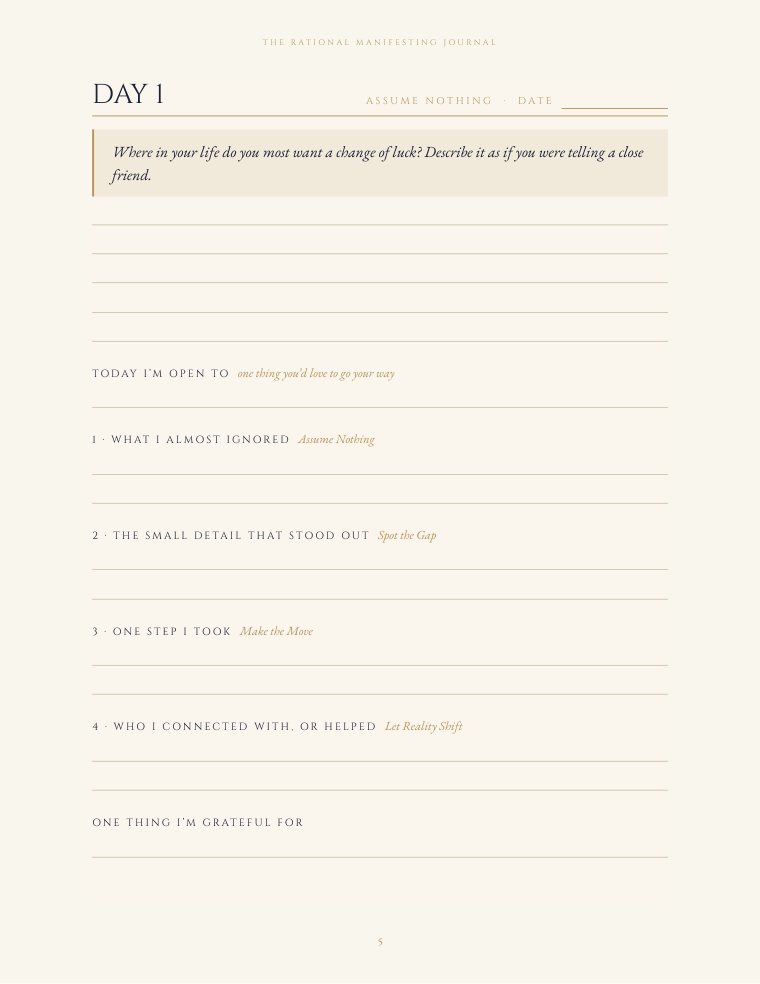
A four-stage method for meeting luck halfway. It comes from a true story from 1729, and from thirty-six more like it. It takes about ten minutes a day.
Three PDFs. One payment. Yours to keep.
You set the intention. You pictured it. You tried to feel as if it had already happened. Then you waited, and when nothing came, somebody told you that you hadn’t believed hard enough.
We think that is unfair, and we think it is wrong. Luck was never a test you could fail by feeling the wrong way.
Some things are out of your hands. That is how the world is, and no method changes it. What you can change is how much of what passes near you gets seen, understood and acted on. Most advice about luck stops at the feeling. We keep the feeling, and add what to do while you wait.
Keep believing. Keep asking for signs. Then learn to notice the ones already in front of you.
Voltaire was in his mid-thirties, just back from exile, well known and short of money. At a dinner party he sat next to a young mathematician named La Condamine, and the talk turned to the new state lottery.
Anyone holding a government bond could buy a ticket. A ticket on a small bond cost one livre. A ticket on a bond ten times larger cost ten. Both had the same chance of winning the same jackpot.
All of Paris could read those rules. One man did the sum. A group that bought the cheap tickets would hold most of the chances for far less than the prize was worth.
They gathered friends, bought the tickets, and came back every month. The government took them to court, and the court ruled they had broken no rule. Voltaire’s share is thought to have been around half a million livres. He never needed a patron again, and he spent nearly fifty more years writing what he believed.
Voltaire did not find the flaw. He showed up, he listened, and he acted. Anyone can practise those.
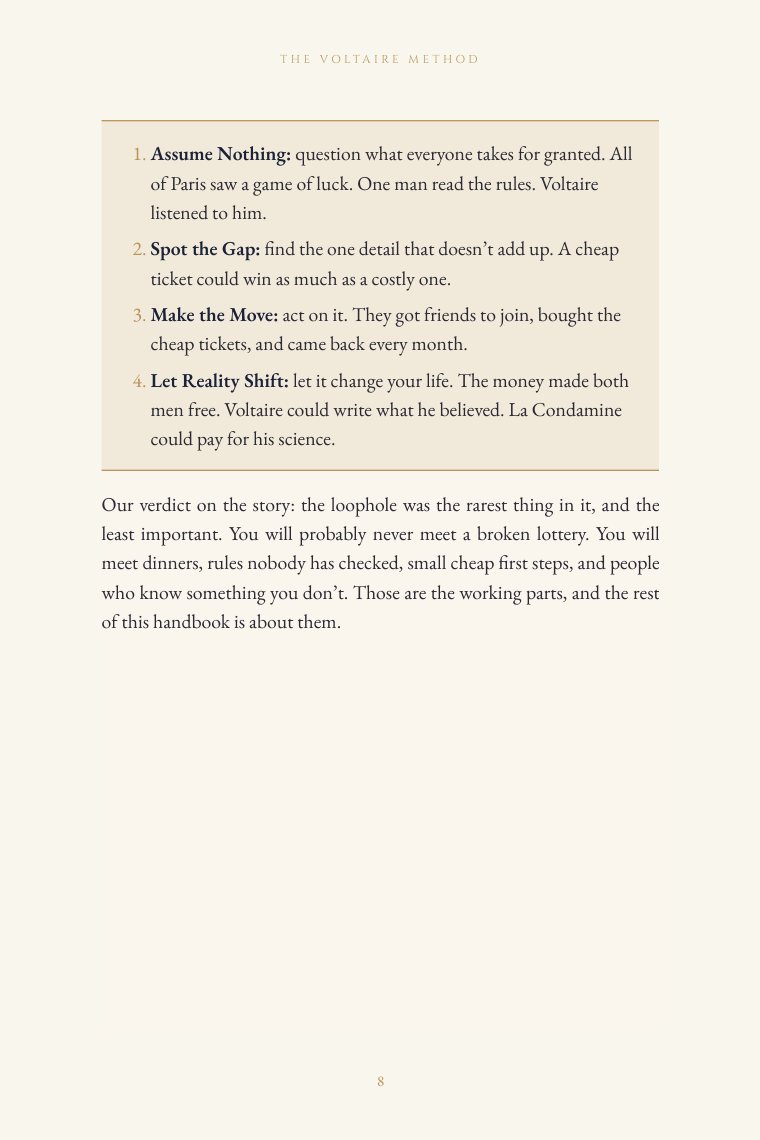
Question what everyone takes for granted.
All of Paris saw a game of luck. One man read the rules. Voltaire listened to him.
Find the one detail that doesn’t add up.
A cheap ticket could win as much as a costly one.
Act on it, small and soon.
They got friends to join, bought the cheap tickets, and came back every month.
Let it change your life.
The money made both men free. One wrote what he believed. The other paid for his science.
Assume Nothing → Spot the Gap → Make the Move → Let Reality Shift
We found the same four stages behind Fleming’s unwashed dish, Ramanujan’s third letter, Faraday’s handmade book and thirty-three other stories. You will probably never meet a broken lottery. You will meet rules nobody has checked, and people who know something you don’t.

The four stages, one chapter each: the idea, the research behind it, how to practise it, and where people usually slip.

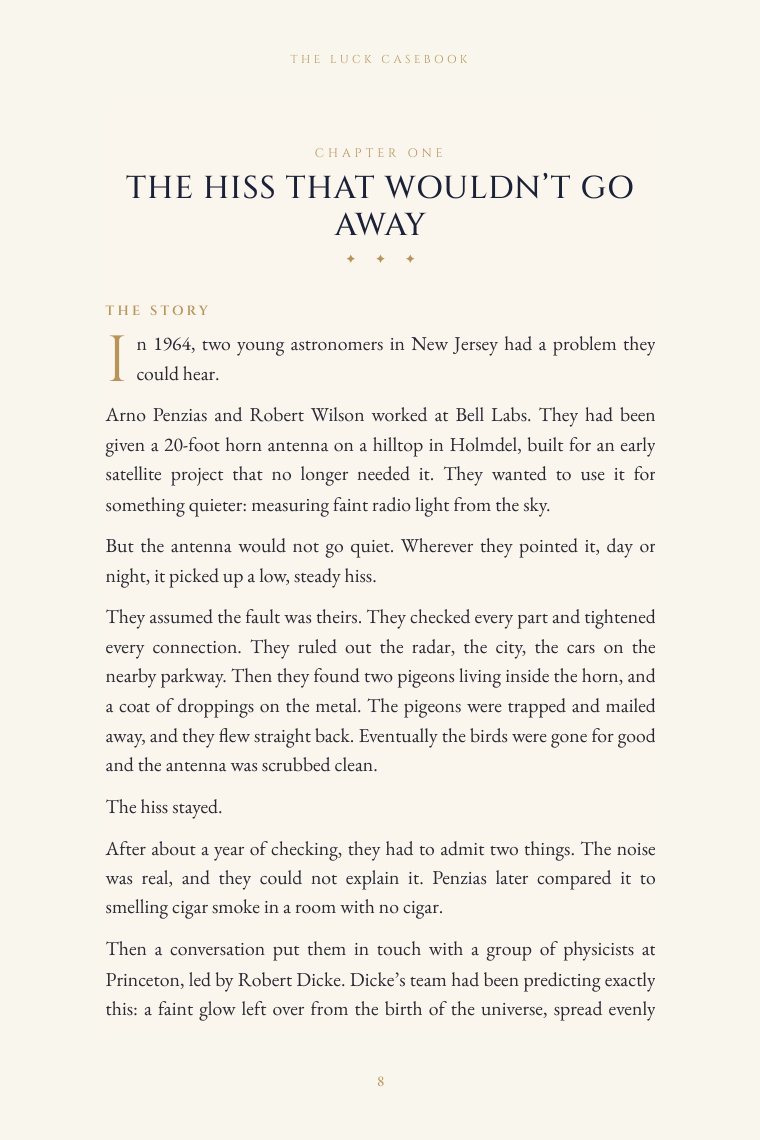
Thirty-six true stories of people who seemed to get lucky, nine for each stage. A hiss that wouldn’t go away. Eight milkshake machines. A letter sent a third time.

Thirty days, one page a day. A prompt, four short lines, and one thing you’re grateful for.
You pick one part of your life. You run the four stages on it for seven days. Then you look at what happened and run it again.
The handbook draws on work by Richard Wiseman, Daniel Simons and Christopher Chabris, Mark Granovetter, and Peter Gollwitzer and Paschal Sheeran. Full references are in its Sources and Notes.
Three PDFs, instant access
Checkout and delivery are handled by Whop.
It starts where that leaves off. We agree that what you expect changes what you do, and the handbook shows the research on that. Then it covers the part that usually gets left out: noticing, checking, acting and talking to people.
No. Keep all of it. The method adds a habit of noticing the signs that are already here, including the ones you’ve trained yourself to overlook.
About ten minutes a day, and one real conversation a week. A missed day is skipped, never made up.
We can’t promise that, and nobody honestly can. The method changes how many chances you see and act on. What comes back, and when, is outside anyone’s control.
Three PDF files: the handbook (39 pages, 6×9 in), the Casebook (114 pages, 6×9 in) and the Journal (44 pages, letter size, made for printing). You get them in your Whop account straight after checkout.
Yes. The Luck Casebook is $9 and the Journal is $7. The handbook comes only with the Complete System.
Yes. How Voltaire Beat the Lottery is a free 10-page guide with the full story and a 7-day practice.